The control layer · Definition
The layer that decides before an agent acts.
Inside Kordio
A decision your team can inspect.
 Kordio workspaceProduct preview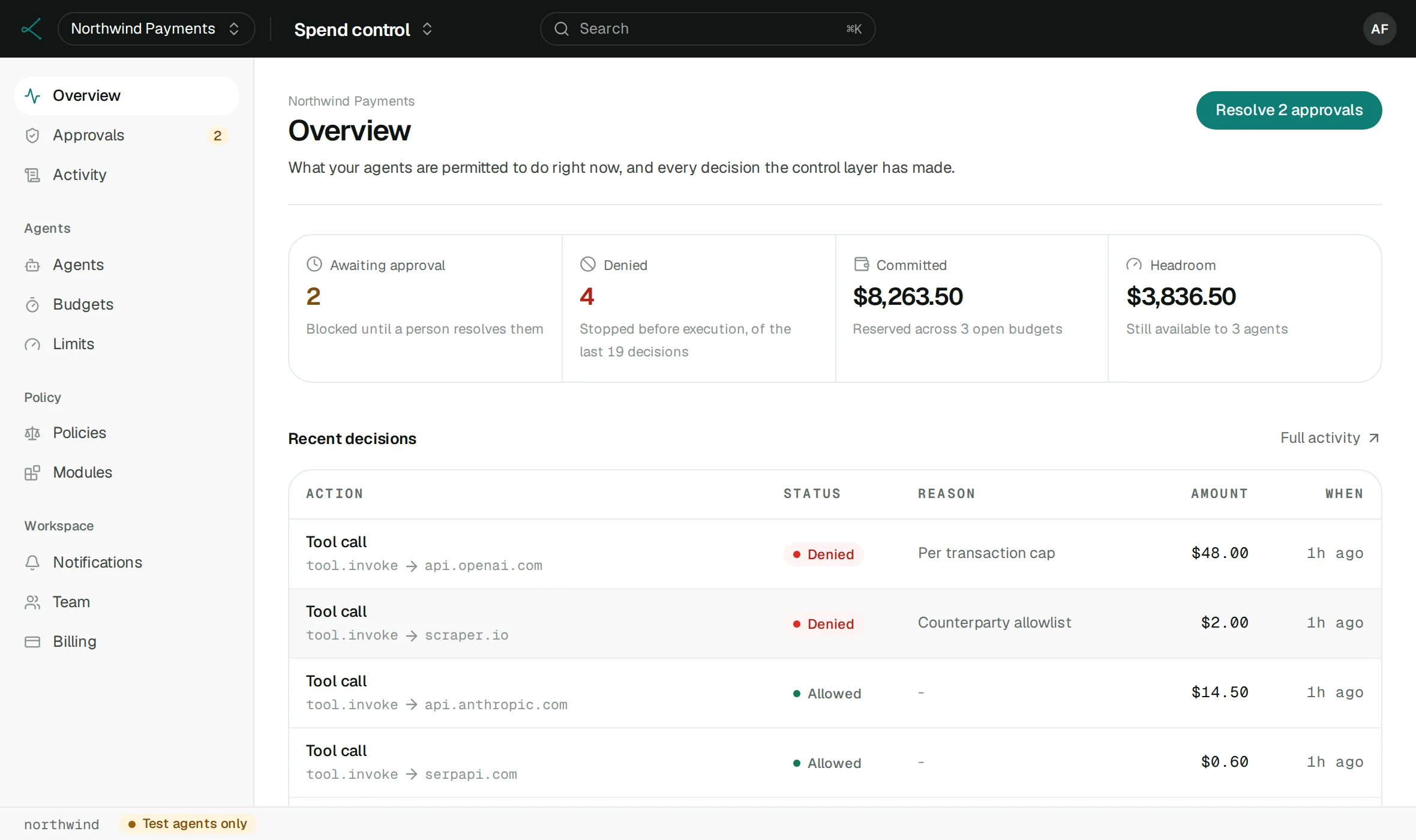
Definition
What an agent control layer has to do.
Decide before, not report after.
The check runs in the path of the action and returns in time to stop it. Anything that tells you afterwards is a record, and a record binds nothing that already had the means to act.
Hold state the agent cannot hold.
A ceiling on one transaction is not a budget. Knowing that this agent has $340 left this month means keeping a running total across runs, sessions and sub-agents, outside the process being limited.
Govern actions, not just payments.
A paid tool call is spend. If the layer only understands card transactions, the largest line on an agent operation is invisible to it, and limits on one kind of spend do not constrain the other.
Produce something an executor can verify.
A decision only the agent carries is a claim. A signature over exactly what was permitted lets whoever executes check the authority without calling back and without trusting the caller.
Name the rule, later.
Months afterwards, someone asks who approved a payment. The answer has to be a rule and a decision on record, not a code review from six weeks ago.
The shape of it
Ask, decide, sign.
The agent describes the action
An agent, a session, an action type, a resource, and a cost. Described before it happens, not reported after.
Policy runs outside the agent
Caps, windows, allowlists and approval thresholds evaluate together, and the first rule that decided is the one named in the answer.
The answer carries proof
An allowed decision comes back signed and short-lived, so the executor verifies the authority offline instead of taking the agent's word.
Not this
Things that get called a control layer and are not.
Position
In the call path, or nowhere.
The honest limit, stated plainly.
A control layer only binds the paths you route through it. An executor that never asks Kordio and never verifies a signature is not governed by it, and no amount of policy changes that. This is worth knowing before you buy, from anyone.
The mitigation is the next sentence: put the check in front of the spend, in code the agent cannot skip, and have the executor require a signature. Once it does, an agent that skipped the check has nothing to present.
Every decision is recorded in an append-only audit trail, linked by trace id, on every tier. See what comes back
{
  "decision": "allowed",
  "rule": "cost_cap.vendor_payments",
  "remaining_cents": 34000,
  "cosignature": "eyJhbGciOiJFUzI1NiJ9..."
}Terms
Words that get used interchangeably and should not be.
Is a control layer the same as guardrails?
No. Guardrails usually validate content: what a model says. A control layer decides actions, holds budget state across runs, and returns a decision an executor can verify.
Is it the same as observability or FinOps tooling?
No. Those report what was spent after the fact. A control layer answers before the action runs, and a denial means the spend never happened.
Do I need one if I only run one agent?
Probably not. A hard-coded cap in your own code is fine for one agent with one ceiling. The trigger is the second agent, or the first time someone asks who approved a payment.
What happens if an agent skips the check?
It is not governed. A control layer binds the paths you route through it, which is why the executor should require a signature rather than trusting the caller.