Kordio Ledger · Fintech
The ledger under every user balance.
For neobanks · wallets · BaaS platforms · remittance apps · lenders
- Balanced by construction
- Append-only journal
- Multi-asset, multi-currency

This is Kordio Ledger, the record half of the platform. Kordio Control decides what your software may spend before it spends; the ledger keeps the books for what it did.
Fintech
One workspace for the financial record.
 Kordio workspaceProduct preview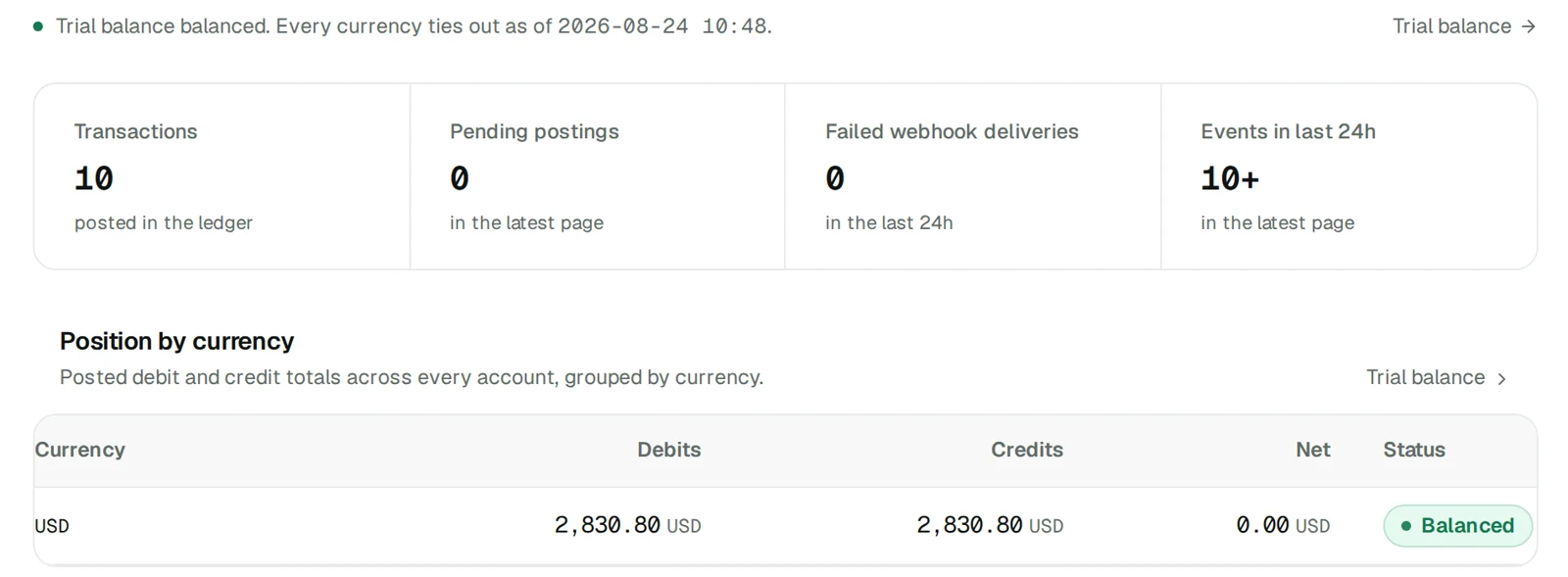
The friction
Where fintechs hit the ledger wall.
- 01
Every product needs its own ledger.
Wallet balances, card float, savings pockets, lending payouts. Each one starts as a Postgres table and ends as a critical-path microservice nobody wants to own.
- 02
User balances drift from provider truth.
Your BaaS partner, your card issuer, and your bank feed all report slightly different numbers by end of day, and the customer app just picks one.
- 03
Every new market is a rewrite.
A new currency, a new correspondent, a new local rail: another ledger fork, another reconciliation job, another set of on-call pages.
Why Kordio
Built for the way fintechs actually operate.
- One journal for every user.
- User balances, product accounts, fees, and revenue lines share one operating model. Balances update the moment a posting commits, no eventual consistency.
- Multi-currency from day one.
- USD, EUR, GBP, USDC, or any symbol you define, in integer minor units. Cross-currency movement posted explicitly, so FX P&L is a query, not a spreadsheet.
- Reconciliation against real providers.
- Load bank feeds, BaaS partner exports, and card processor statements; match against postings; flag what's off-book. Replayable, so a missed match is never permanent.
By the numbers
What "always balanced" looks like.
- $0
- Sandbox plan
- 100%
- Balance invariants
- 5min
- Signup to first API call
- 1API
- Integration
Where to go next
Three questions, in the order people ask them.
- What the ledger does
- Balanced postings, reconciliation against what actually cleared, period close, and the reports finance asks for.
- Build it, or buy it
- When writing your own is the right call, the five signals it has run out, and the eight things that cost more than the schema.
- What it costs
- Priced on postings a month, not on seats. Free in test mode with no card, and every number published.