Use case · Agent spending limits
A limit the agent cannot raise.
- Tools and payments in one ceiling
- Survives sub-agents
{
  "action_type": "tool.invoke",
  "resource": "api.openai.com",
  "cost_cents": 900,
  "currency": "USD"
}{
"decision": {
"outcome": "denied",
"rule": "run_budget_exhausted",
"headroom": { "budget_remaining_cents": 0 }
}
}The eleventh sub-agent gets the same answer as the first one would have, because they share the envelope.
Inside Kordio
Know what each agent can spend.
 Kordio workspaceProduct preview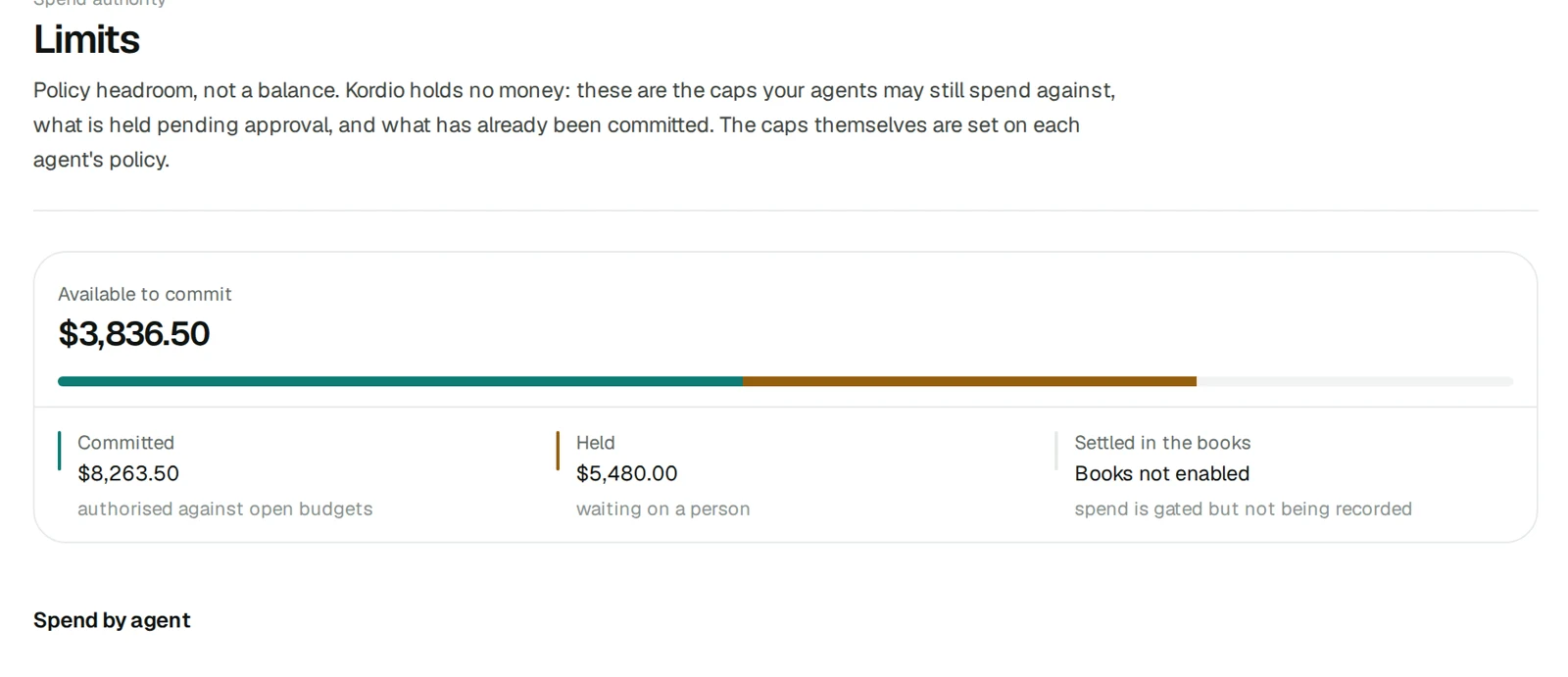
Why the usual answers stop short
Four limits that are not a limit.
The longer versions: versus an if statement in your orchestrator and versus card limits.
The envelope
One budget, delegated down, released on the way back.
{
  "mode": "allowlist",
  "rules": [
    { "kind": "spend_window", "max_cents": 25000,
      "window_seconds": 86400 },

    { "kind": "rate_limit", "max_actions": 200,
      "window_seconds": 60, "action_types": ["tool.invoke"] },

    { "kind": "cost_cap", "max_cents": 5000,
      "action_types": ["payment.create"] },

    { "kind": "condition", "effect": "require_approval",
      "rule_name": "unknown_vendor",
      "when": { "not": { "field": "resource", "operator": "in",
        "value": ["api.openai.com", "api.anthropic.com"] } } }
  ]
}
The daily window covers every action type at once, so a runaway loop on tools eats the headroom the payment would have needed.
The part that is not a config flag
An allowed decision comes back signed.
Honest limit, stated plainly: a control layer only binds the paths you route through it. More on what that means in what an agent control layer is.
Questions
What engineers ask before wiring it in.
Does this replace the guardrails in my agent framework?
No, and keep them. They catch things Kordio never sees, like what the model is about to say. The difference is that a framework hook holds no budget across runs and cannot produce evidence that anything was authorized.
Does Kordio add latency to every tool call?
One call before the action. Use simulate for a dry decision when you want to check without reserving anything. The ledger projection is deliberately outside the decision path, so books can never slow a decision down.
What if Kordio is unavailable?
You decide the failure mode: fail closed and the agent stops, or fail open and you accept the exposure for that window. We would rather you make that choice explicitly than discover it during an incident.
Can one budget cover model spend and real payments together?
That is the point. Action types are dotted strings, so tool.invoke and payment.create draw down the same envelope. Spend on one consumes headroom for the other.
Does an agent need a card or a wallet for this?
No. Kordio holds no funds and issues nothing. It decides and it signs. Whatever executes the action still executes it.